Choose how you run Akka
You run Akka in one of five deployment options. In the self-managed option you operate Akka yourself. In the other four, Akka Automated Operations (AAO) operates the platform for you: it handles deployment, scaling, multi-region replication, patching and recovery, so you deploy a service and AAO runs it. Your services are the same code in every option.
The five options
| Option | Who runs the platform | Whose cloud account, and who pays for it | Tenancy |
|---|---|---|---|
Self-managed |
You |
Infrastructure you choose: bare metal, VMs, containers, PaaS or edge. You pay its provider. |
Yours |
Serverless |
Akka, with AAO |
Akka’s cloud account. You pay Akka as you go, by credit card. |
Multi-tenant |
Dedicated |
Akka, with AAO |
Akka’s cloud account. Akka bills you for the region. |
Single-tenant |
BYOC |
Akka, with AAO |
Your cloud account on AWS, Azure or GCP. You pay your cloud provider for the infrastructure. |
Single-tenant |
BYOK8s |
Akka operates the platform, you own the cluster |
A Kubernetes cluster you provide, in your cloud account. You pay your cloud provider. |
Single-tenant |
Dedicated and BYOC are one delivery model in two places: Dedicated is a single-tenant region in Akka’s account, and BYOC is the same region in your account. BYOK8s is BYOC where you provide the Kubernetes cluster. Dedicated adds a private data link to your network; BYOC does not need one, because the region already runs in your account.
In BYOC and BYOK8s, application data stays in your environment. A limited set of platform interactions, such as deployments and key rotation, still crosses to the Akka Federation Plane. How AAO works describes the architecture, and Data flows and security pathways lists every flow.
What AAO adds
AAO is built on a Kubernetes-based control plane and application plane designed to run Akka services. It manages, monitors and gathers insights from your deployed services:
-
Automated deployments, scaling and recovery.
-
Multi-region replication with failover for business-critical workloads.
-
Logs, metrics and traces from the first deployment.
-
Dedicated infrastructure for regulatory or data-sovereignty requirements, in Dedicated, BYOC and BYOK8s.
AAO monitors region health and brings replacement capacity online without operator action.
Availability
Every option that AAO operates runs each service across availability zones in a region, so the loss of one data center recovers automatically. A project can also span several regions, with state replicated between them. Replication between regions is asynchronous: when a region is lost, writes that it accepted and had not yet replicated to another region are not available in the other regions. Moving traffic away from a failed region is an operator action with the Akka CLI. Recovery targets are set in your agreement with Akka. See Choosing your environment to choose between zones and multi-region.
Next steps
-
Self-managed: Operate Akka in a self-managed environment.
-
Serverless: Serverless.
-
Dedicated: Dedicated.
-
BYOC: Get started with BYOC.
-
BYOK8s: Get started with BYOK8s.
When you prepare to go live on Dedicated, BYOC or BYOK8s, see Production readiness.
For project setup, service deployment, monitoring, and automation, see Operating.
Service packaging
The services you build with Akka components are composable, which can be combined to design agentic, transactional, analytics, edge, and digital twin systems. You can create services with one component or many.
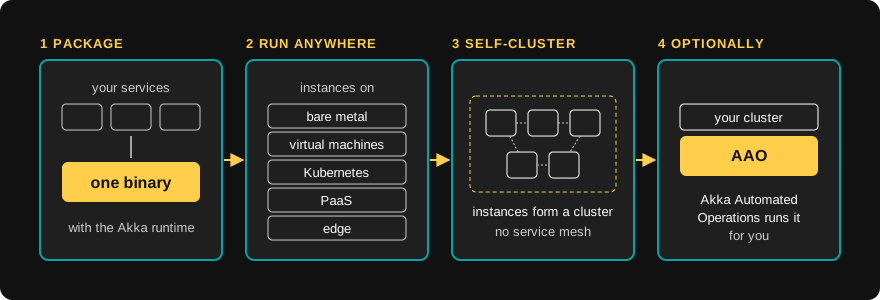
Your services are packed into a single binary. You create instances of Akka that you can operate on any infrastructure: Platform as a Service (PaaS), Kubernetes, Docker Compose, virtual machines (VMs), bare metal, or edge.
Akka services self-cluster without you needing to install a service mesh. Akka clustering provides elasticity and resilience to your agentic services. In addition to data sharding, data rebalancing, and traffic routing, Akka clustering has built-in support for addressing split brain networking disruptions.
Optionally, you can deploy your agentic services into Akka Automated Operations, which provides a global control plane, multi-tenancy, multi-region operations (for compliance data pinning, failover, and disaster recovery), auto-elasticity based upon traffic load, and persistence management (memory auto-scaling).
To compare the ways to run Akka, see Choose how you run Akka.