
About Akka
Akka has one offering: the Akka Agentic AI Platform, which provides resilience and scalability for the agentic systems you build with it. The platform has four solutions:
-
Akka SDK,
-
Akka Specify,
-
Akka Verify and
-
Akka Optimize.
They share one definition of an AI system, one runtime, one ledger and one governance model, so each solution works on what the others produce.
Akka, formerly Lightbend, has run distributed systems in production since 2007. The open-source Akka actor library for the JVM is the lineage of the platform. The platform is a separate product, and this documentation describes the platform.
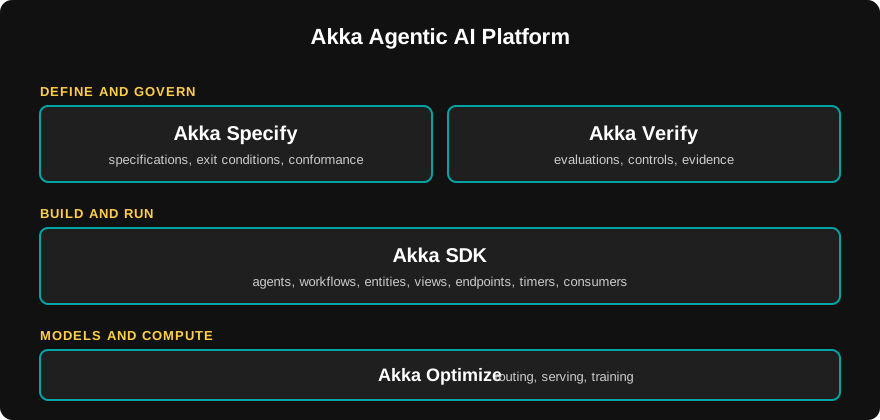
The four solutions
| Solution | What it is | Start in the documentation |
|---|---|---|
The component model for building agentic systems. |
||
Spec-driven development tooling that builds an agentic system from plain-language specifications and checks every change against them. |
||
Runtime-native evaluation, enforcement, evidence and governance for agents built on Akka or elsewhere. |
||
Routes traffic to the best open-weight model and trains smaller ones on your data. |
How the solutions work together follows one agent through all four.
How the platform runs
Everything you build runs on the Akka runtime. You operate it yourself, or Akka Automated Operations runs it for you, on Akka’s serverless cloud or in your own cloud account. Your services are the same code in every option. See How Akka runs.
Where to start
The documentation sections are organized by task. Start from what you need to do:
-
Build an agentic system from a specification: Install using your AI harness, then Spec-first hello agent.
-
Build one in code: Code-first hello agent.
-
Learn how Akka works before you build: How the solutions work together and Concepts.
-
Evaluate and govern agents: Akka Verify.
-
Route, serve or train models, and track what they cost: Akka Optimize.
-
Deploy and operate services: How Akka runs and Operating.